
UNC-INS-090
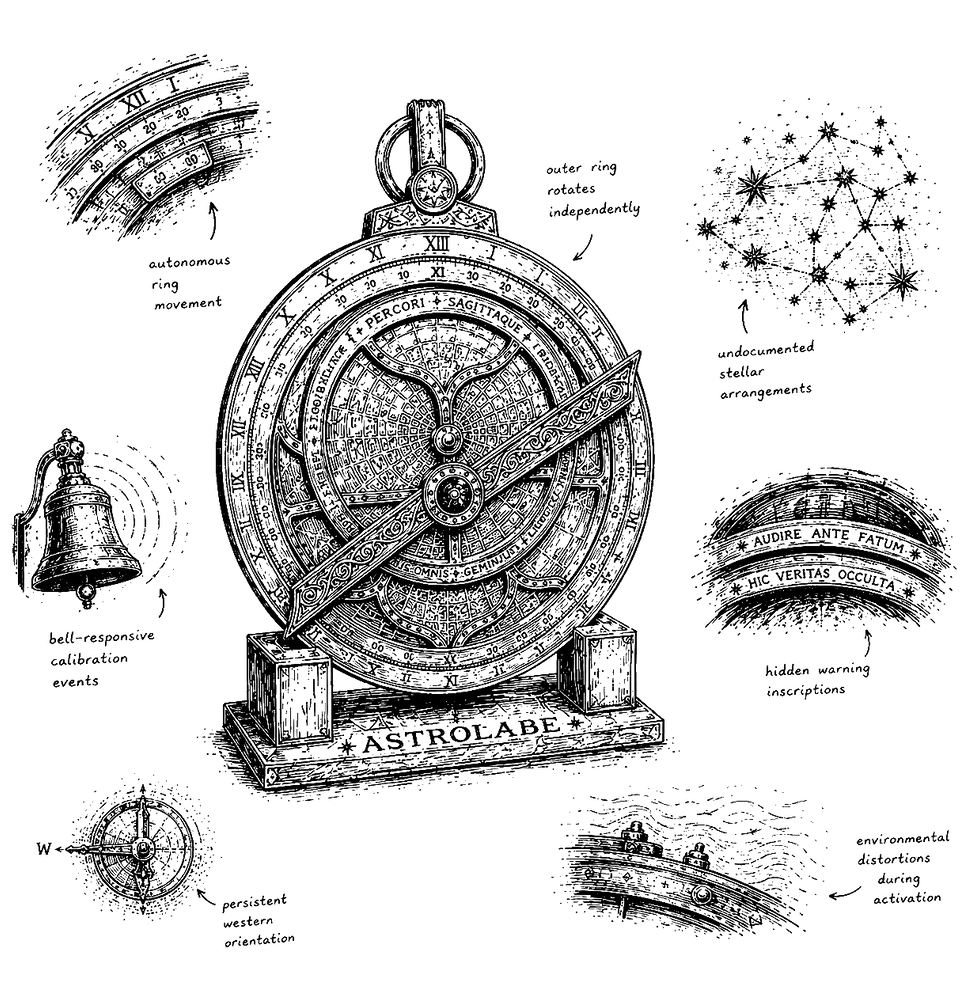
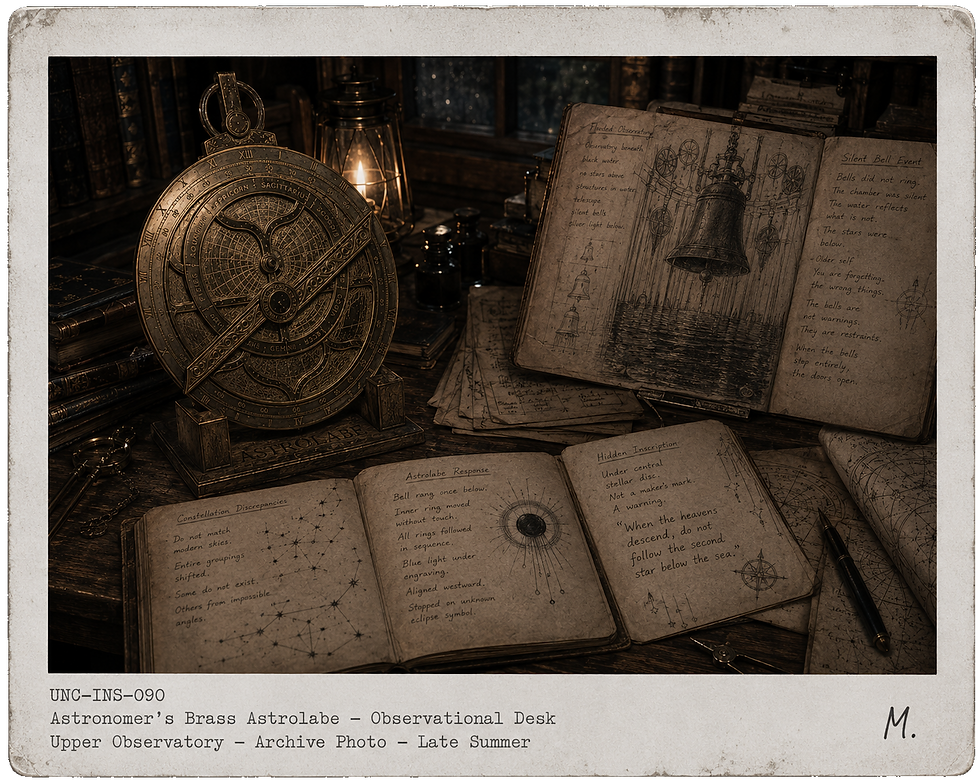
A precision brass astrolabe recovered from the ruined upper observatory of an Ottoman astronomical complex associated with restricted eclipse observation and celestial calculation practices. The instrument consists of interlocking calibration rings surrounding a central stellar disc engraved with eclipse markers astronomical notation and unidentified stellar formations absent from known celestial records. During a Late Summer restoration cycle the astrolabe demonstrated autonomous movement immediately following a documented bell event beneath the archive foundations. Multiple calibration rings rotated without physical input and aligned toward the western horizon overlooking the sea. Concurrent observations included anomalous blue illumination moving beneath engraved stellar markers temporary environmental distortion within the observatory and activation of a previously concealed eclipse symbol repeatedly associated with lower archive dreams and alignment phenomena. Hidden inscriptions discovered beneath the central stellar disc reference descending heavens and warn against following a second star beneath the sea. Evidence increasingly suggests the instrument functions as an alignment detector or navigational device associated with celestial conditions not represented by conventional astronomy.

DETAILS
Handling and Restrictions:
Manual adjustment prohibited during active bell cycles. Document all autonomous movement events. Observation during eclipses requires two-person review and continuous recording.

Keeper Notes:
Instrument demonstrates direct responsiveness to archive alignment activity. Purpose remains incompletely understood and may extend beyond astronomical observation.
Astronomer's Brass Astrolabe
Access Level:
Restricted
Period:
Renaissance Era
Recovery Location
Collapsed upper observatory chamber overlooking the Bosporus.
Condition:
Excellent preservation with minor oxidation. One calibration ring remains permanently misaligned toward the west.
Notable Characteristics
Autonomous ring movement. Undocumented stellar arrangements. Hidden warning inscriptions. Bell-responsive calibration events. Persistent western orientation. Temporary environmental distortions during activation.
Clio Observation
Clio remained attentive throughout calibration movement events and maintained visual focus on eclipse markers during activation periods.
Muninn Observation
Muninn closely tracked each rotating ring during restoration and displayed heightened interest in autonomous movement sequences associated with bell activity.
RELATED ITEMS / LINKS:
RELATED SYMBOLS:

Research Notes:
Constellation patterns correspond with recurring symbols documented within alignment diagrams drowned observatory records bell studies and western star references. Instrument may track celestial positions unavailable from the current sky or monitor alignment conditions associated with archive stabilization systems.
Cross References:
Lantern Map Cabinet | Bell Alignment Diagrams | Silent Bell Event | Observatory Clock | Drowned Observatory | Unknown Coordinate Compass | Furnace Stairwell | Celestial Orrery
