
MYT-OBJ-074
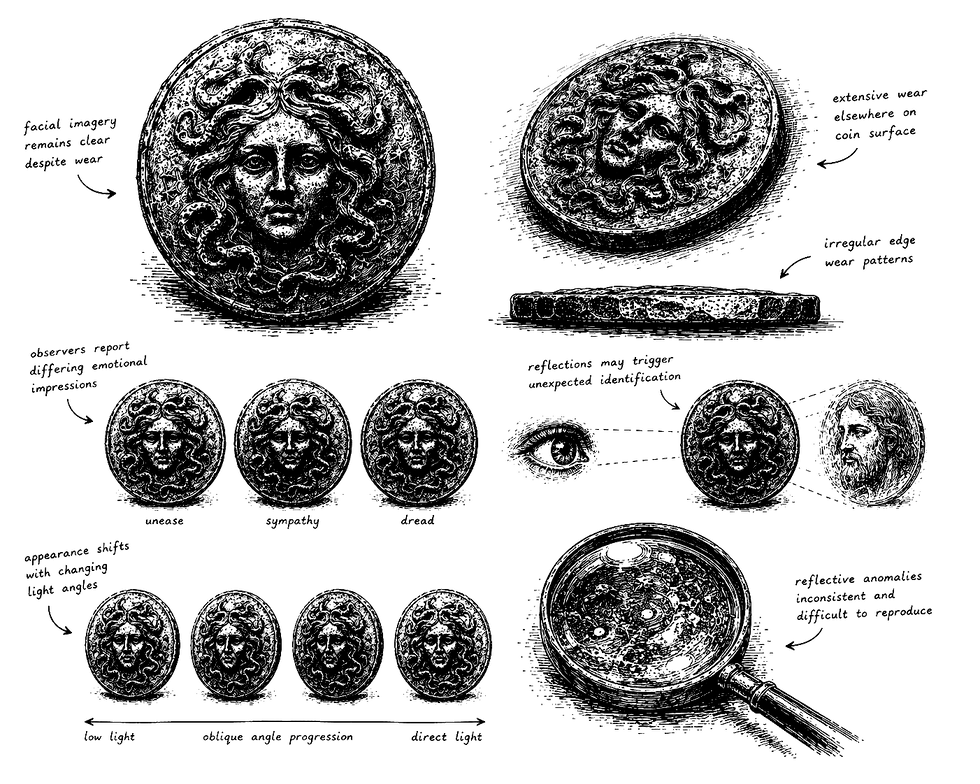
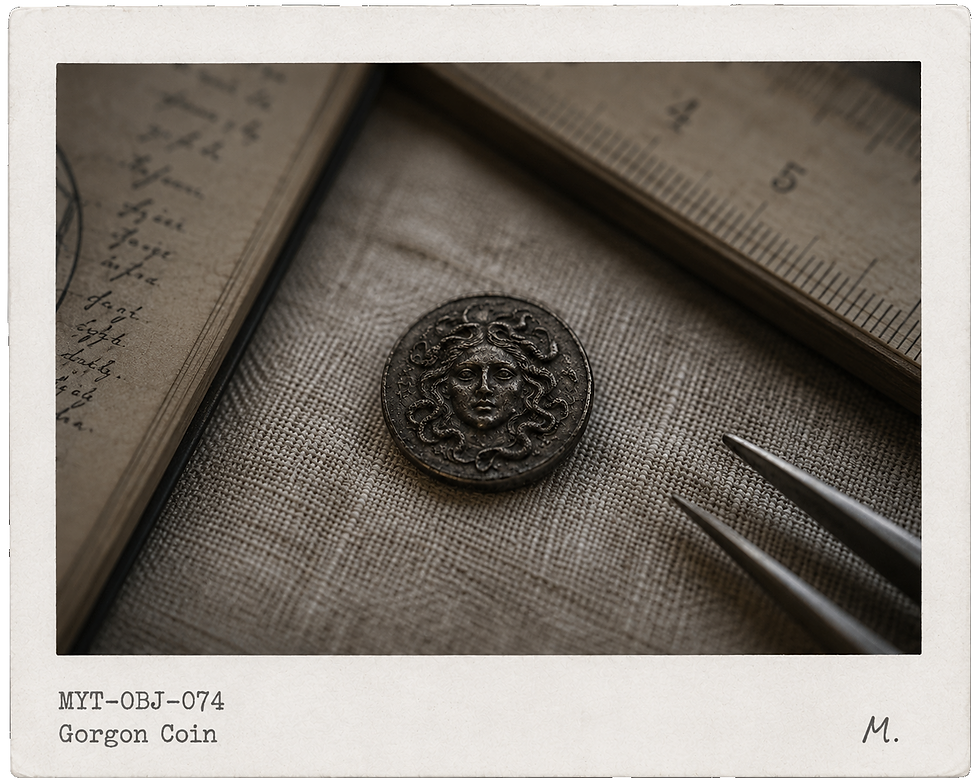
The Gorgon Coin is a ceremonial bronze coin recovered from a concealed merchant cache beneath the ruined trade districts surrounding ancient Corinth. The artifact bears a remarkably well-preserved Gorgon visage surrounded by intertwined serpentine forms despite extensive wear affecting much of the surrounding surface. Recovery excavations documented shattered amphorae, sealed trade ledgers, burned olive oil residue, and ceremonial masks associated with merchant guilds and temple societies practicing protective and funerary rites.
Surviving records reference �the face that must not be reflected� and describe marked coins carried during dangerous sea voyages, funeral processions, and warding ceremonies intended to protect travelers from misfortune and spiritual harm. Archive examinations have repeatedly documented unusual reflective behavior associated with the engraved face. Observers frequently report strong personal identification with reflected or perceived versions of the image, particularly during prolonged examination or under changing light conditions.
The artifact remains one of the most significant examples of Gorgon symbolism preserved within the Mythica collection and continues to be studied for its unusual relationship with memory, identity, and perception.

DETAILS
Handling and Restrictions:
Reflective testing, mirrored observation, photography involving reflective surfaces, and prolonged visual fixation prohibited.

Keeper Notes:
Examinations should be documented using multiple observers and non-reflective recording methods whenever possible.
Gorgon Coin
Access Level:
Restricted
Period:
Classical Era
Recovery Location
Excavated from a collapsed merchant vault near the ruined trade districts surrounding ancient Corinth
Condition:
Stable with light corrosion and preserved engraved detail.
Notable Characteristics
Facial imagery remains unusually clear despite extensive wear elsewhere on the coin.
Observers frequently report differing emotional impressions during examination.
Reflections occasionally produce unexpected identification responses.
Perceived facial characteristics may appear subtly altered under changing light conditions.
Reflective anomalies remain inconsistent and difficult to reproduce under controlled conditions.
Clio Observation
Avoids prolonged fixation on the engraved face and remains unusually attentive during examination periods.
Muninn Observation
Frequently arranges reflective objects around the artifact and becomes agitated during imaging or reflective testing attempts.
RELATED ITEMS / LINKS:
RELATED SYMBOLS:

Research Notes:
Associated with Classical Greek protective traditions, funerary rites, maritime warding practices, and Gorgon symbolism. Current research suggests the artifact's effects may relate more closely to identity, memory, and self-perception than conventional visual distortion phenomena. Similar themes appear throughout several Archive objects connected to mourning, remembrance, and personal recognition.
Cross References:
Mourning Spirit Mirror | Maritime Recovery Coin | Historical M Preservation Logs | Sealed Key
