
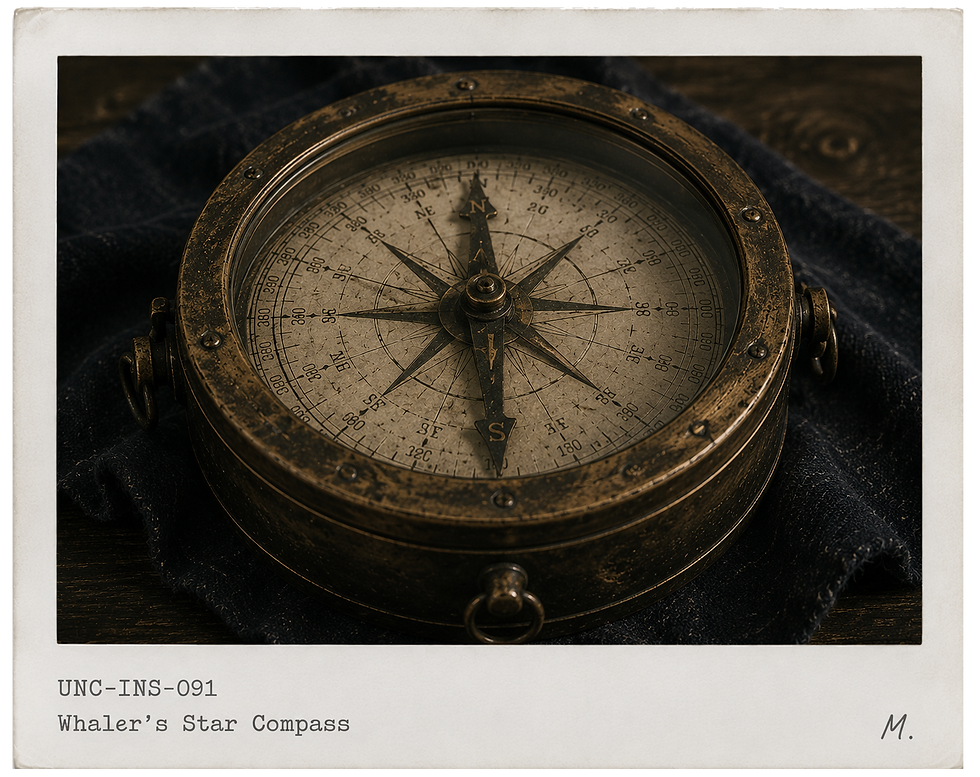
UNC-INS-091
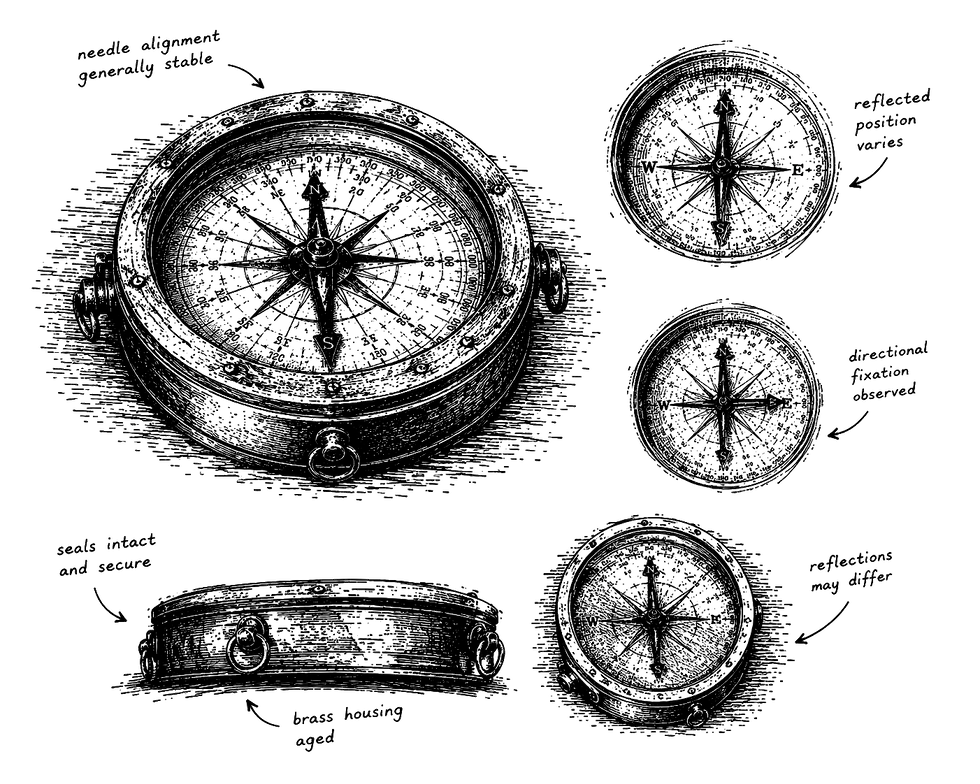
The Whaler's Star Compass is a maritime navigation instrument recovered from the bridge remains of an ice-locked nineteenth-century whaling vessel discovered in northern waters. The artifact displays preserved directional assemblies stable calibration under ordinary conditions and intermittent episodes of severe directional instability. Recovery teams documented frozen navigation charts fractured sextants whale oil lanterns and water-damaged astronomical journals surrounding the recovery site. Surviving crew records reference �the star that turned against the sea� and describe navigators experiencing route deviations directional confusion and unusual maritime phenomena during prolonged fog conditions. Recent observations documented the compass needle orienting downward toward the foundations of the Archive before later rotating westward toward the sea beyond the cliffs. During these events observers reported maritime memory impressions dense fog manifestations and discrepancies between the physical needle position and its reflected image. The artifact remains one of the most significant navigational anomalies within the maritime collection.

DETAILS
Handling and Restrictions:
Maritime transport offshore calibration testing and prolonged directional observation sessions prohibited.

Keeper Notes:
Compass behavior appears to escalate during periods of increased maritime anomaly activity and should be monitored alongside related artifacts.
Whaler's Star Compass
Access Level:
Restricted
Period:
Age of Exploration
Recovery Location
Salvaged from the bridge remains of a frozen nineteenth-century whaling vessel
Condition:
Stable with moderate surface wear and preserved navigational assemblies.
Notable Characteristics
Needle alignment remains stable under most conditions but periodically demonstrates directional fixation inconsistent with terrestrial navigation systems. Reflected needle positions may differ from physical observations.
Clio Observation
Remained unusually close during observation periods and maintained physical contact with the cloth beneath the artifact for extended periods.
Muninn Observation
Avoided direct proximity during active directional fluctuations and remained within the upper conservatory beams throughout the event.
RELATED ITEMS / LINKS:
RELATED SYMBOLS:

Research Notes:
Possible connection to drowned harbor traditions maritime bell phenomena offshore procession routes anomalous star navigation and ceremonial sea voyages. Probable British maritime origin. Associated geometric procession symbols recovered from the vessel remain under investigation.
Cross References:
Barnacle-Covered Bell | Frostbitten Sextant | Shipwreck Compass Core | Water-Damaged City Fragment
